Welcome to The Isle of Clegg Forum
Art, News, Intellections & Poesy
Aiden's Heron
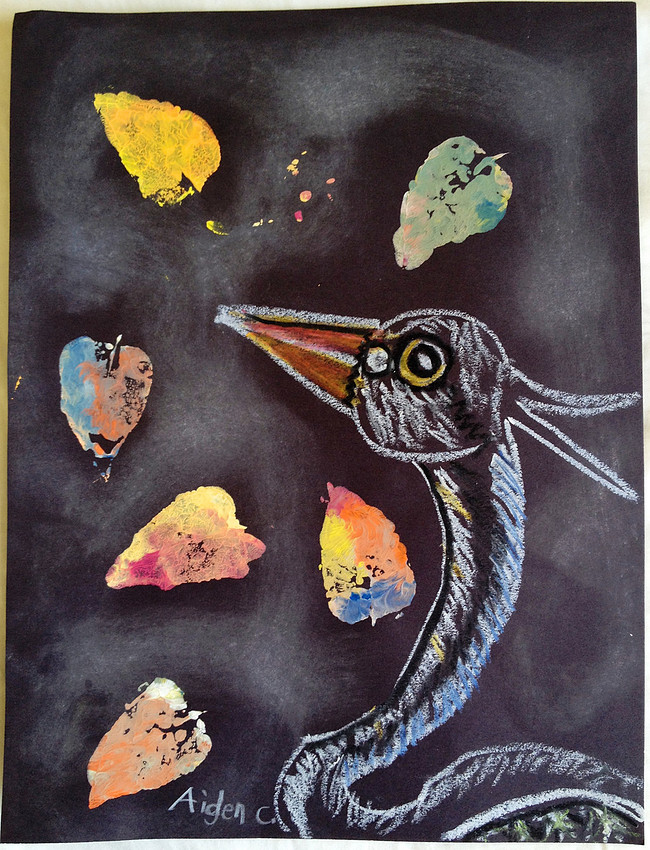

Drawn within the past few weeks in art class, Aiden was very pleased with how his Heron and Leaf Print project turned out. Mommy and Daddy were most impressed.
"Spiky Devil"
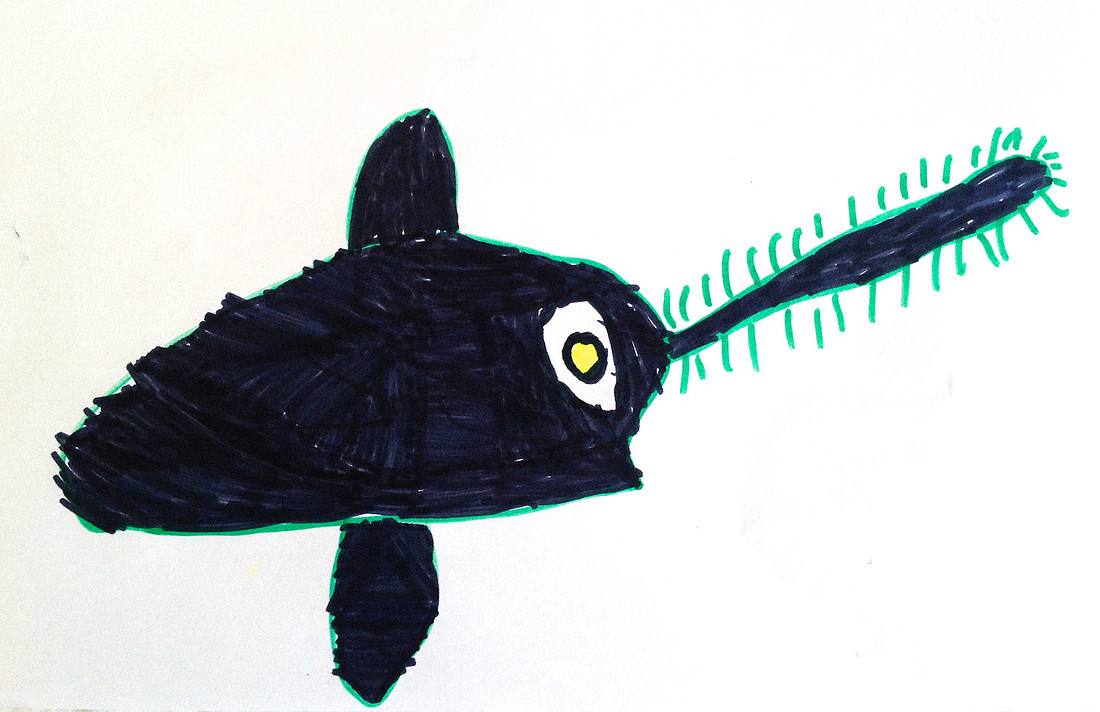
Aria drew this picture of a Sawfish- which she named "Spiky Devil" today. She is tends to be enthralled by viscous, monstrous or deadly animals, but somehow always manages to soften them with her delight, laughter and six year old spirit...
Salmon School: Background and Musings on Chum Salmon
SALMON SCHOOL
Background & a few thoughts to go with our family "Salmon Run" video:
Chum Salmon
(Oncorhynchus keta) Also called Dog, Keta, or Calico Salmon
Kingdom: Animalia
Phylum: Chordata
Class: Osteichthyes
Order: Salmoniformes
Family: Salmonidae
Genus: Oncorhynchus
Species: keta
This species of Pacific salmon ranks as the second largest behind the Chinook, and has the largest geographic distribution of the six species of Pacific salmon. Their current range is from the waters off northern Oregon north to Canada's Mackenzie River, across the Bering Sea to the northern watersheds of Sibera west to the Lena River Basin, south through the Sea of Okhotsk, southward in the eastern Pacific to the island of Kyushu in the Sea of Japan and the coastal watersheds of Korea. Chum Salmon are the least commercially valued salmon species, probably due to their milder flavor, but there IS a limited market for them in Japan and Europe, and they are a major source of dried salmon products. Chum Salmon are marketed under the name Silverbrite. And of course theres's nothing like misspelling "bright" in a marketing name to add oodles of class to whatever your selling!
Like the other five Pacific salmon species, Chum Salmon hatch from eggs in countless creeks, rivers and tributaries which drain adjacent terrestrial watersheds. The tiny hatchlings- "Fry" take a year to migrate downstream into into the ocean. They eat insects, zooplankton, and small marine invertebrates. Ever-growing, salmon fingerlings become juveniles and eventually migrate to the rich feeding grounds of the northern Pacific ocean where they feed chiefly on smaller fish and grow for 3 to 5 years. Most reach an adult weight of 9-20 lb.s and 24 inches in length. Once fully mature, and approaching the end of their 4-7 year lives, they migrate back to the very creeks where they hatched.
Moving from the saltwater ocean to a freshwater stream is catastrophic for salmon physiology. The fresh water has less oxygen and their adult gills are poorly suited to extract it. Salmon kidneys- used to much higher salinity- shut down, and with kidney failure, toxins begin to build up in their blood. So they swim, upstream against the currents, exhausted and dying, trying to reach their birthing grounds. Many die trying to get there. But some tattered, battered, champions push themselves back to the small eddy's, pools, gravel bars, and sandy creek bottoms from whence they came. Surviving females dig nests and lay thousands of eggs, surviving males release sperm to fertilize them. After spawning, the salmon adrenal glands release all their remaining corticosteroids and as their bodies essentially fall apart, dying females spend their remaining energy covering the nest- burying the eggs with sand or gravel. Shortly thereafter, all the adult salmon die.
Decaying adult salmon rot along the banks of the creeks, and while it does't smell too pleasant to walk creekside for a week or two after a salmon run, all that decomposing fish provides an unbelievably rich source of nutrients for the whole ecosystem. Plants, trees, insects and all sorts of animals benefit- the forest itself is fertilized by these fish. It's a system that naturally moves nitrogen and minerals form the great masses of plankton and fish in the vast Pacific Ocean, and allows terrestrial organisms including humans to grow and thrive on it. Everything from the tiny plankton to fish that lost their lives when they were eaten by salmon, now fortify the hefty cedars and redwoods which grow in soil enriched with the energy from those ocean creatures: Energy, which is directly transferred from ocean to the forest as the salmon decay.
This "food web" sustained by wild Chum salmon used to extend much further south along the Pacific coast of North America. Chum Salmon used to thrive off central California: where they once swam in vast schools through the Golden Gate past San Francisco and up the Sacramento River. Chum Salmon used to swim up creeks and rivers at least as far south as Monterey in California.
But not anymore.
Dams on rivers cut the salmon off from their breeding grounds, pollution and "development" of wetlands and marshes have eliminated safe habitats for the fingerling salmon to mature. Dredging and "engineering" of our rivers has altered water flow and eliminated the suitable sand and gravel beds needed for the salmon to lay their eggs. Industries and automobiles releasing carbon dioxide into the atmosphere are warming the planet, and and even tiny increases in water temperatures in salmon streams reduces oxygen levels in the water making streams too warm for eggs to remain viable and hatch. Commercial floating "salmon farms" have brought in foreign fish which producers call "Atlantic Salmon" with different genetics and new diseases and parasites that weaken and kill natural wild Pacific salmon. As tough and strong as wild Pacific salmon are, humanity is driving them to extinction.
In North America, there are virtually no HEALTHY wild Chum salmon runs left outside Alaska. But in the Pacific Northwest they are still here. Threatened, weakened, and even a few officially endangered populations are still hanging on. Every year, local rivers and creeks receive variable numbers of returning wild Chum salmon that head upstream to spawn. These seasonal migrations are a highlight of our year. However, as we tend to encounter these unscheduled natural events on rainy Fall days when the creek levels rise a bit around Puget Sound, the combination of serendipity and inclement weather has up till recently kept me from putting together a family video about salmon runs.
With our consumer camcorder, (and my unwillingness to make our whole day about video production by lugging a tripod everywhere) it turns out to be quite difficult to take good video of these somewhat camouflaged fish covered by reflective moving water in the diminished Autumn light on stormy days. Nonetheless, this year I got some useable video, and have posted it with the title "Salmon Run" on the video gallery portion of this website. I will also post this email on our website as well.
Anyhow, it was again our privilege this year to experience a decent run of Chum Salmon in a nearby creek. Our video will obviously convey only some tiny fraction of what we saw, but if you don't live near a salmon stream or have never seen a Salmon run we hope we can share something fantastic with you even if it's just a glimpse. It's an under ten minute video of our family along the banks of Chico Creek on a blustery Fall day we enjoyed together as these marvelous lurching fish struggled mightily upstream in concert with the rhythms of nature's balanced nourishing grandeur.
-Tiffin
P.S. The regulations on salmon fishing could fill a whole book, but you will see some fishermen at the mouth of the creek at the start of the video. The rule is that you can catch a salmon in the open water but once it enters a creek, it is protected and there is no fishing allowed. You will see that it looks like people are fishing in the creek where it enters the sound, but this is a bit of a grey area I guess. Functionally as the tide goes in and out the creek becomes variably shorter and longer. Evidently there is a fixed point at the mouth of the creek that constitutes the "beginning of the creek" and since we were there at a lower tide, the part of the creek extended by the receding tide is apparently fair game for fishing?….
The Smiling Carrot Family
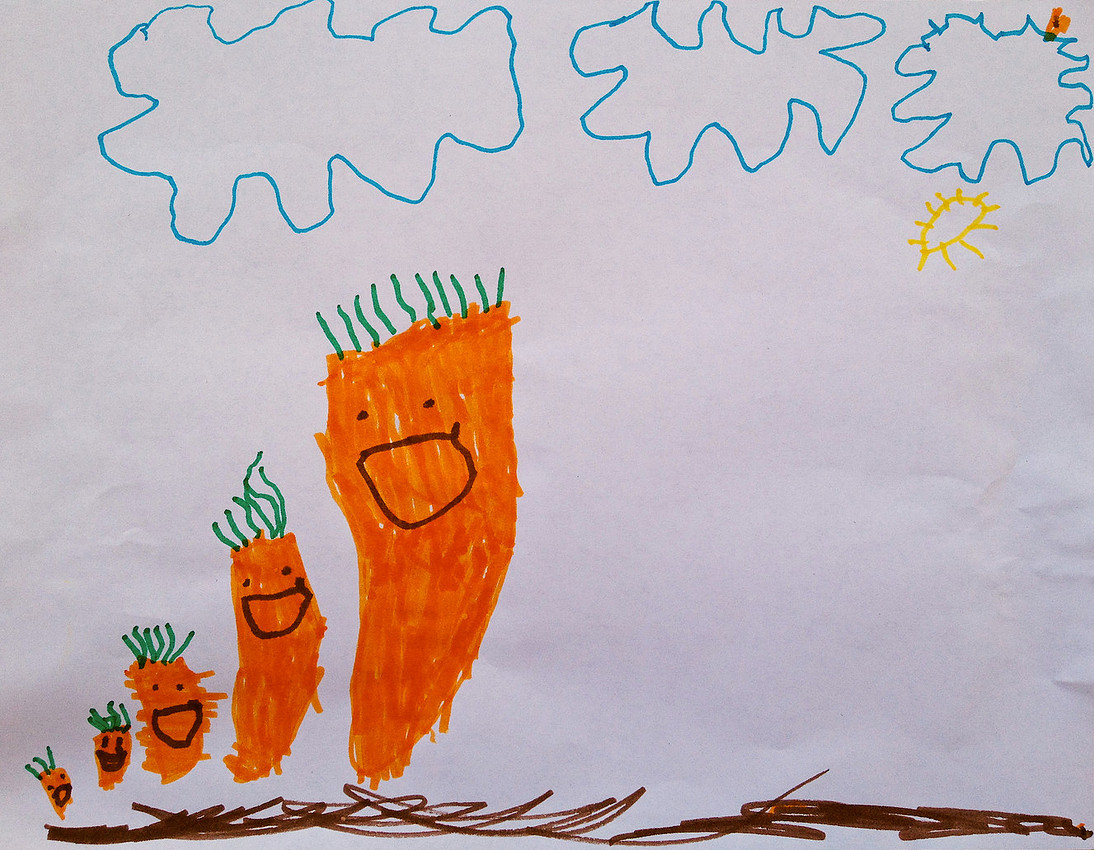
Aria drew this picture of "a smiling carrot family on a sunny day" last night and it seemed to be a perfect illustration to fill the anchor position in our "Isle of Clegg Forum" which we plan to use for sharing creative endeavors, family news, thoughts, or whatever creations we manage to upload.
Aria explained that she drew a family of smiling carrots including a newborn carrot, the sun, and clouds in the sky. She seemed especially proud of her cloud outlines and asked if we thought anyone else would do them that way. In the upper right corner, she said she was testing one of her pens but then decided it should be a bird.